إعـــــــلان

تقليص
لا يوجد إعلان حتى الآن.

Tunisian ancient roman town .. Sufetula

تقليص
X
 
  • تصفية - فلترة
  • الوقت
  • عرض
إلغاء تحديد الكل
مشاركات جديدة

  • تلميذ باحث
    رد
    المشاركة الأصلية بواسطة jassar مشاهدة المشاركة
    .That s really amazing . i hope you have More subjects about Cartage too .
    follow these safe links

    Tunisian ancient Roman towns

    Cathage.. Punic Memories

    Carthage .. Roman Period

    Carthage .. Museums

    Roman towns and monuments directory

    for more pictures and photos of monuments ... wikimedia commons
    اترك تعليق:


  • تلميذ باحث
    رد

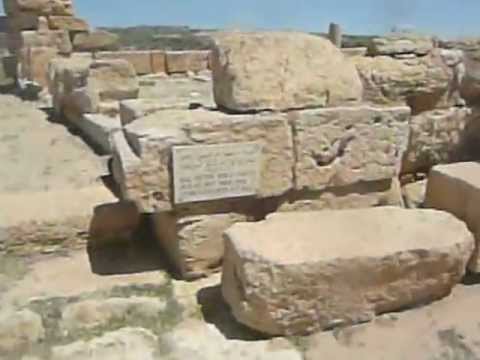
    Tunisia trip - Sbeitla (Sufetula) roman ruins
    Chinese tourist camera
    *


    اترك تعليق:


  • تلميذ باحث
    رد
    المشاركة الأصلية بواسطة jassar مشاهدة المشاركة
    .That s really amazing . i hope you have More subjects about Cartage too .
    yes i do .. give me some time to gather informations and multimedia
    take a look on this publication... Carthage: Grandeur et Décadence

    اترك تعليق:


  • jassar
    رد
    .That s really amazing . i hope you have More subjects about Cartage too .

    اترك تعليق:


  • تلميذ باحث
    رد

    Basilica of Vitalis


    The baptistry basin of the Basilica of St Vitalis is quite important to get in on your visit to Sbeïtla.


    Its shape is quite beautiful, so are also the details.
    It may however be overlooked, as it is set in a separate chamber behind the apse of the church. It dates back to the end of the 6th century.


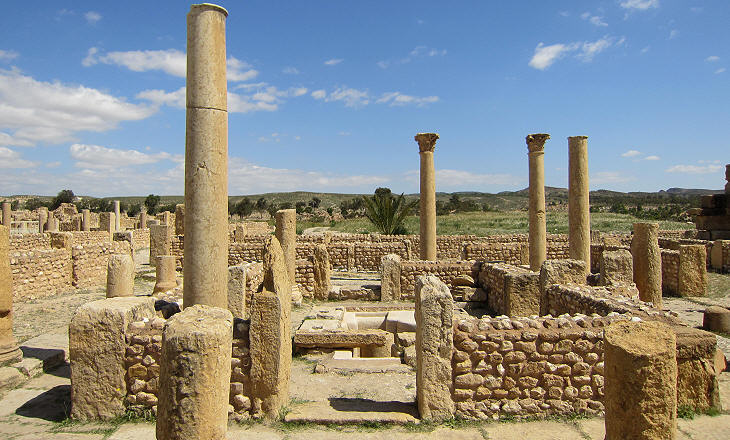
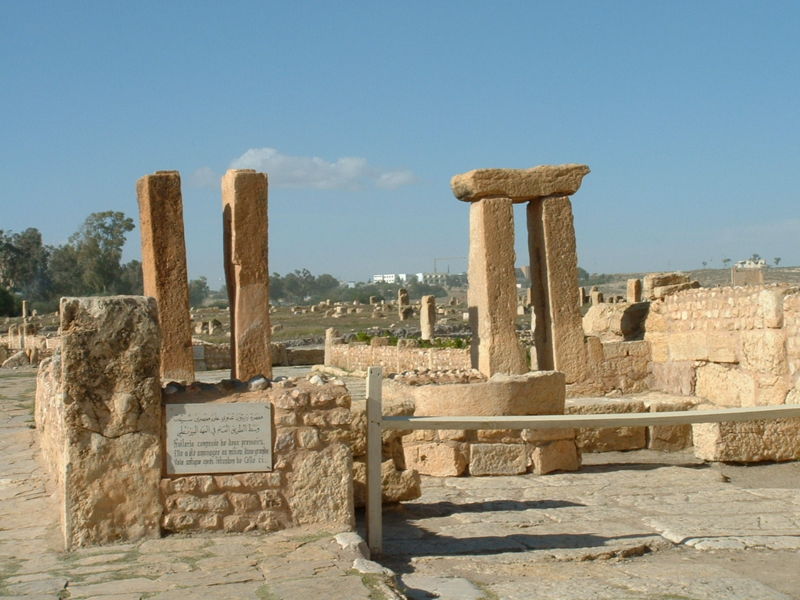
    The photo below shows another baptistry basin, built as a part of the Basilica of Bellator.
    Far less attractive, it is still noted for its 4 original columns. It is about 200 years older than the one in Basilica of St Vitalis. The surrounding walls are a later addition, when it was converted into a chapel dedicated to Bishop Jucundus.

    Mosaic details


    اترك تعليق:


  • تلميذ باحث
    رد

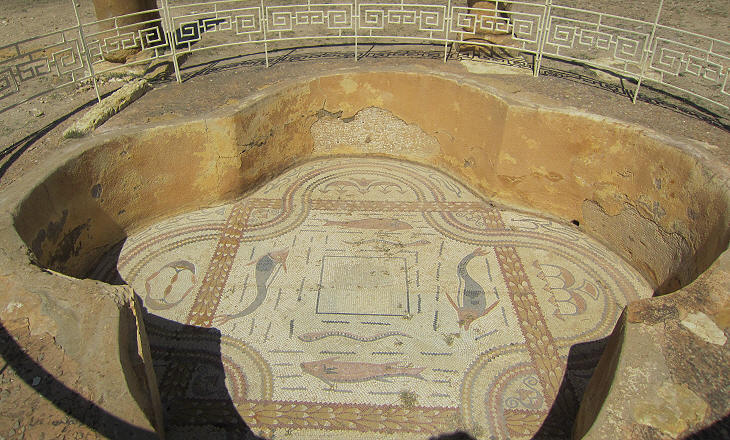
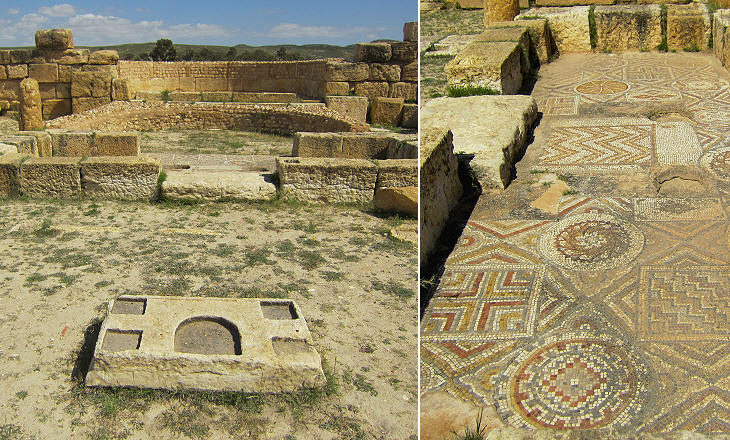
    Archaeologists have found a second basin near the Basilica of Vitalis. Its origin and purpose are not fully explained.

    The four lobes could be interpreted as a reference to the Cross and the fish of the mosaic as Christian symbols, but most likely it was a decorative fountain at the centre of a Roman peristyle.

    Basin near the Basilica


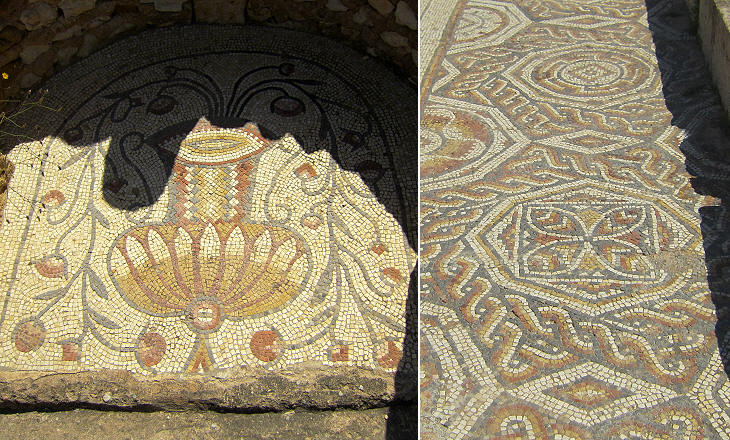
    The mosaics wich decorated the the christian monuments of Sufetula were geometric with very few exceptions such as the Khantaros in the baptistery of Bellator.

    Mosaics: (left) Baptistery of Bellator; (right) Basilica of Vitalis


    This jar was a symbol of Dionysus, the Greek god of wine.
    It was often depicted with a grapevine growing from it, as in some Roman baths along Via Appia.

    (above) Mosaic depicting a grapevine growing from a "Kantharos", a cup used for drinking wine; (below-left) geometric mosaic; (below-right) relief on the wall of a farm built near the site of the baths


    It was adopted by the early Christians as a symbol of life with apple trees replacing grapevine


    other picture of basilca of Vitalis


    In 646 Gregory, the Exarch (governor) of Byzantine Africa, rebelled against Emperor Constans II on religious grounds.

    It was a very difficult moment for the Byzantine Empire: Egypt and Syria had just been conquered by the Arabs.

    In 647 Arab raiders invaded Africa and Gregory tried to check them at Sufetula, but was killed and the town plundered.
    Eventually the Arabs agreed to withdraw from the province, but a few decades later they returned and conquered it.


    ./.


    اترك تعليق:


  • تلميذ باحث
    رد

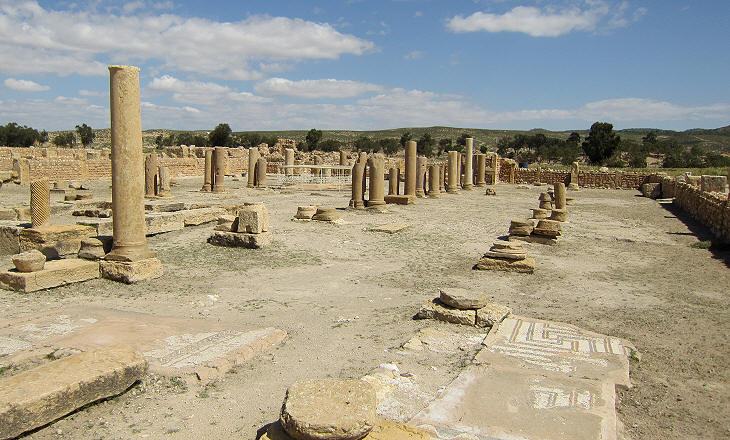
    A second large church was built near that of Bellator. Similar to that of Servus it has five naves.
    It has two opposite apses, the smaller one was probably used for funerary ceremonies.
    Some sources date it late Vth century/early VIth century which would mean it was built during the Vandal occupation of the country. The Vandals were Arians and perhaps the basilica was their cathedral.

    Basilica of Vitalis


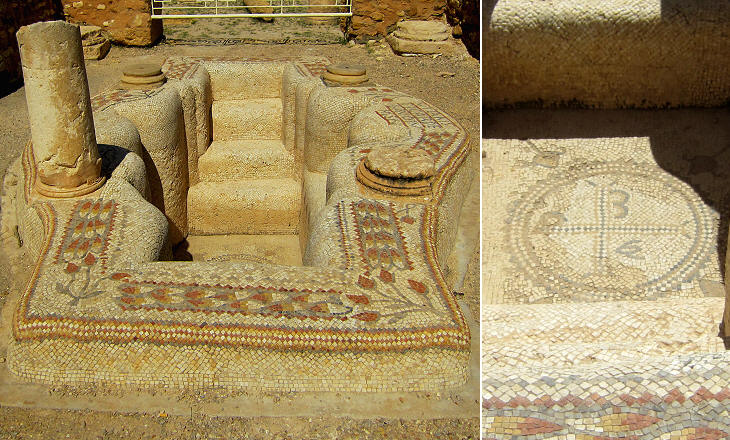
    The basilica was named after one of the donors of its baptismal font who is mentioned in an inscription .
    The font was decorated in fulfilment of a vow and was completed by a canopy supported by four columns.
    With that of Kelibia it is the finest example of baptismal fonts found in Tunisia.

    Basilica of Vitalis: (left) Baptistmal font; (right) Christogram


    Baptism was a key sacrament for the early Christians and St. Augustin wrote a treatise to prove that the Donatist position on baptism was wrong.

    In particular he condemned the Donatist practice of baptizing a second time those who returned to the Church after having abandoned it.


    اترك تعليق:


  • تلميذ باحث
    رد
    المشاركة الأصلية بواسطة anonyme مشاهدة المشاركة
    nice work..thx for the info
    thanks bro ther .. you 'r welcome .. there's more info to publish
    thanks for your support

    اترك تعليق:


  • anonyme
    رد
    nice work..thx for the info

    اترك تعليق:


  • تلميذ باحث
    رد

    The area to the north of the Forum houses several Christian churches and chapels which were all built on the site of previous temples and public buildings.
    It is interesting to note that it does not appear that the Capitolium was turned into a church which indicates that it was regarded more as a monument to the emperors than to pagan deities.

    The church of Bellator
    (after the name of a local bishop) was built in the IVth century as the cathedral for the orthodox community. It was modified in the following centuries when new apses were added.


    Church of Bellator: (left) apses and in the foreground holes where
    wooden structures were placed; (right) details of its mosaics


    The peristyle of an adjoining building which likely housed a fountain at its centre was turned into a baptistery, which later on became a separate chapel.
    It is named after Jucundus, a bishop of Sufetula who attended a council at Carthage in 411. At that council (St.)
    Augustin, Bishop of Ippona, today's Annaba in eastern Algeria, claimed that Donatists should be regarded as heretics and his position was eventually adopted by the chairman of the council, an envoy of Emperor Honorius.


    Baptistery of Bellator or Chapel of Jucundus


    اترك تعليق:


  • تلميذ باحث
    رد

    Sufetula is the ancient Roman town of Tunisia which retains the largest number of Christian monuments. This because in the VI th century it became the most important town of Valeria Byzacena, the province created in Central Tunisia by the territorial reforms introduced by Emperor Diocletian in 285-292.

    The capital of the province was Hadrumetum (today's Sousse), but it lost importance in favour of Sufetula, where new churches were built until the VIIth century.


    Three churchs were discovered : the church of Servus , the church of Bellator and the the basilica of Vitalis


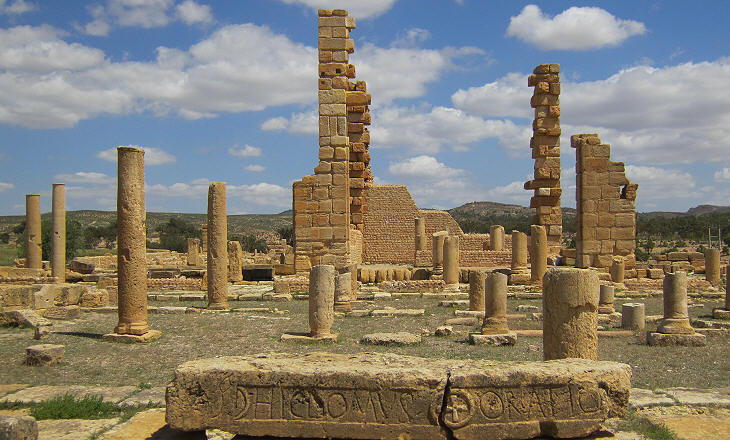
    The Church of Servus (thus named after an inscription) was one of the earliest ones and it is situated between the Forum and the Great Baths. It had five naves and it was built using the columns of a Roman courtyard which preceded a temple.

    Church of Servus; in the foreground lintel of the entrance gate with the inscription "Hic Domus Oratio(nis)" meaning "This is the House of Prayers"


    Archaeologists believe that it was the Donatist cathedral of Sufetula. Donatism was a Christian sect which flourished in the IVth century in northern Africa. It probably had some ethnic/territorial roots as it was more popular in inland towns than in coastal ones. Emperor Honorius issued decrees punishing the members of the sect, which however is believed to have survived until the Arab invasion in the VIIth century.


    اترك تعليق:


  • تلميذ باحث
    رد

    The north-western part of Sufetula is still to be entirely excavated.
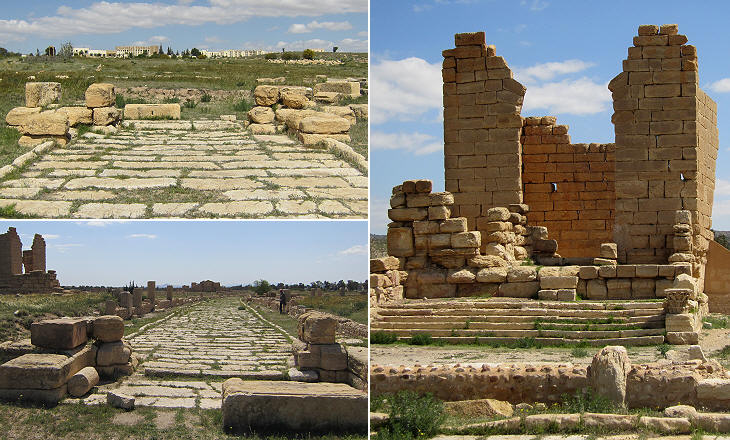
    An arch dedicated to Emperor Septimius Severus marked its northern entrance and beyond the arch the site of a small amphitheatre has been identified.

    (left-above) Site of the arch dedicated to Emperor Septimius Severus and behind it that of the amphitheatre;
    (left-below) view from the arch showing the straight road leading to the Forum; (right) temple near the arch (unknown dedication)


    A large Roman house indicates that the part of the town near the northern entrance was mainly a residential one.
    The house was enlarged by acquiring parts of other adjoining houses and it was used in Byzantine times. It is named after a mosaic portraying the Four Seasons which has been moved to the Museum of Bardo in Tunis.


    left) House of the Seasons )
    right) details of decoration
    The lintel has a typical Byzantine features


    اترك تعليق:


  • تلميذ باحث
    رد

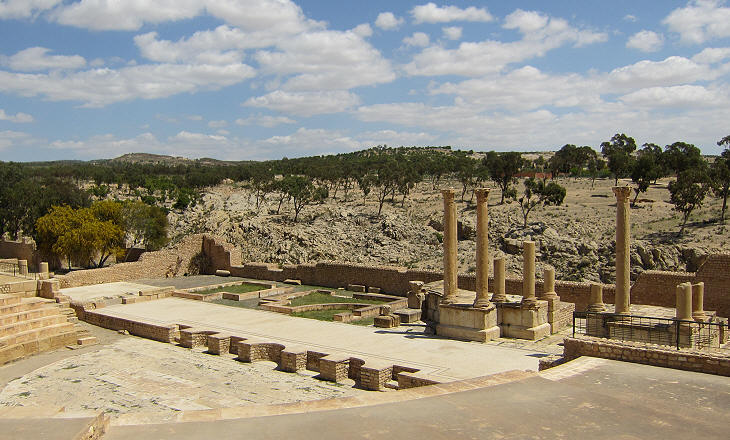
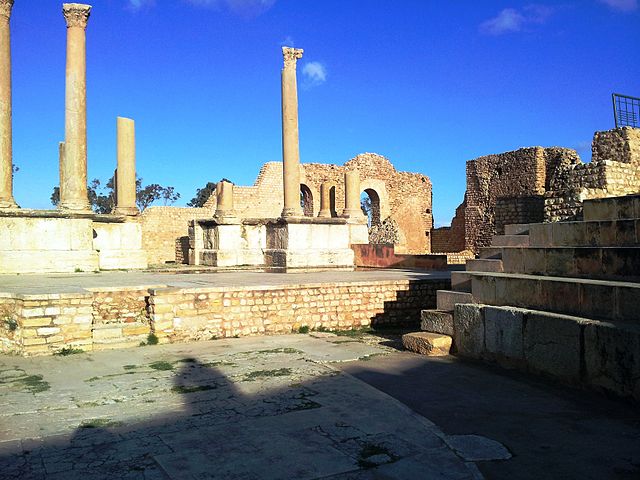
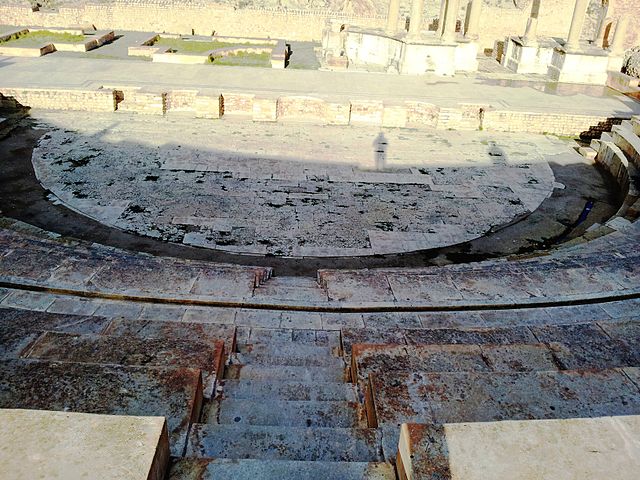
    The theatre of Sufetula was built at the edge of a ravine created by the small river to the east of the town. What we see today is largely a modern reconstruction.


    Sufetula is a "must see" among the archaeological sites of Tunisia, but Sbeitla, the modern town, does not benefit much from its visitors, who rarely spend a night there, as they usually see it on their way from Kairouan (north-east of Sufetula) to the oasis of southern Tunisia.


    اترك تعليق:


  • تلميذ باحث
    رد

    Sufetula was a town of some 5,000 inhabitants in the interior of the country and, even though the Romans founded towns in the oasis of southern Tunisia, it was almost at the border of the Empire.

    Yet its temples were accurately decorated with mouldings and capitals, which indicates a wide circulation of treatises on architecture and engineering.
    Vitruvius, the Roman writer of De Architectura, a treatise on such matters, said that a building should have firmitas, utilitas, venustas i.e. that it should be solid, useful and beautiful and at the Capitolium of Sufetula his guidelines were complied with.


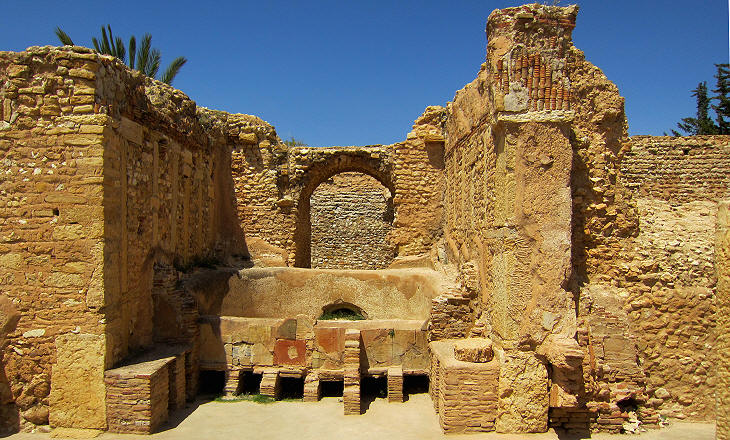
    The main baths of Sufetula were located a short distance from the Forum.
    Archaeologists have identified a twin set of halls which has led them to believe that a section of the baths was utilized in winter and the other one in summer.
    Inscriptions making reference to restorations indicate that the baths, which were built in the early IIIrd century, were in use during the Byzantine period, possibly until 647 when Sufetula was plundered by Arab raiders.


    Hall of the Great Baths


    great bath palester


    frigidarium


    One of the small baths: (left) heating system; (right) detail of a mosaic


    heating system


    Archaeologists have identified at least four other baths, one of which was part of a private house which has been in part destroyed by the construction of a modern road.
    Professional excavations at Sufetula started in 1906 and were abandoned a few years later. Unfortunately steps were not taken to forbid building in areas which were likely part of the ancient town

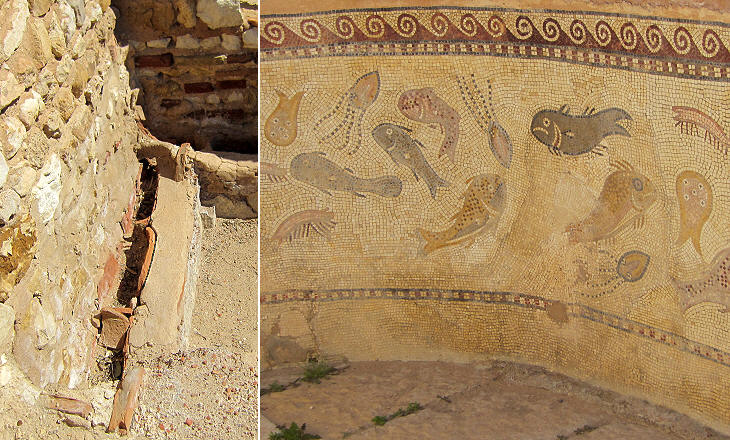
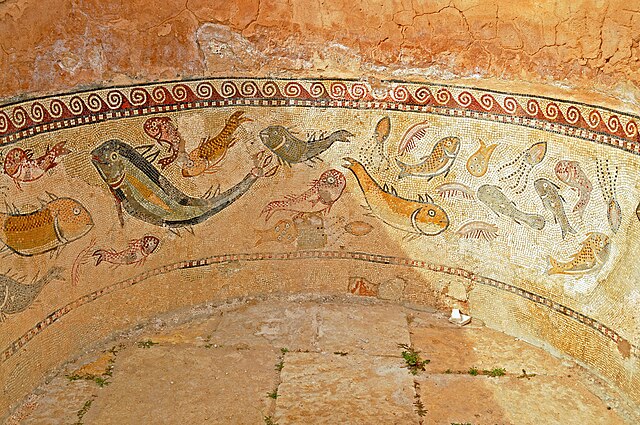
    baths with fish mosaic


    large fountain


    fountain house


    water reservoir


    اترك تعليق:


  • تلميذ باحث
    رد

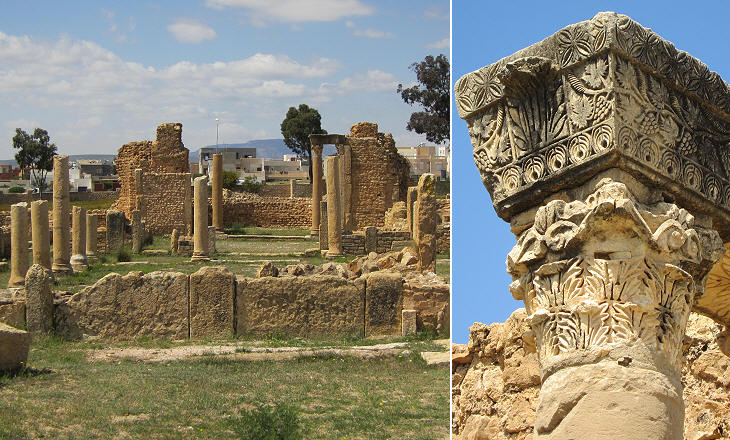
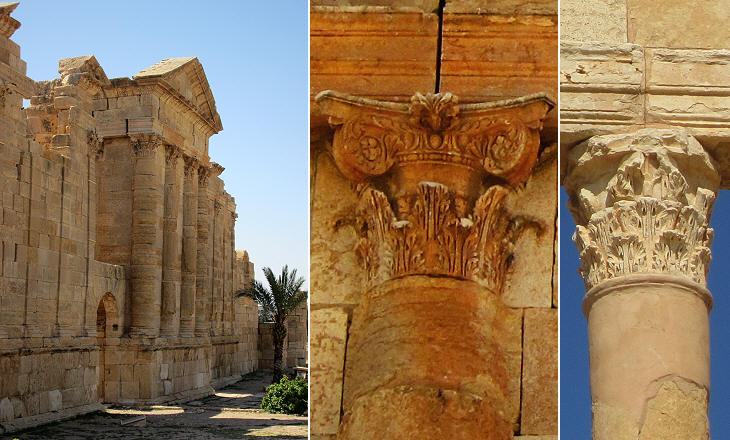
    The Capitolium was built at the same time as the arch and as other similar temples at Thugga and Thuburbo Majus. These temples were mainly meant to celebrate the achievement of a higher status of the town in the Roman administrative system or the granting of Roman citizenship to its inhabitants.

    Capitolium: (left) rear side; (centre) capital on the rear of Jupiter's cella; (right) column on the front of Juno's cella


    During the IInd century AD the Roman Empire experienced a long period of peace and economic growth. One of the consequences was that Rome was no longer perceived as the centre of a foreign power, but as that of a community which the citizens of the provincial towns were proud to be part of


    It is pleasantly situated upon a rising ground, shaded all over with juniper trees. A little brook glides along the N.E. side of it, which afterwards loses itself in the sand.

    Sufetula was a great producer of olive oil at the time of the Roman Empire.
    Some inscriptions found in the city suggest that the settlement had success along the lines of others in North Africa during the 2nd century, reaching great prosperity through the olive industry, whose cultivation benefited from excellent climatic conditions in the region.

    The olive presses found in the ruins of the city further bolster this conclusion. The resulting prosperity made possible the construction of a splendid forum and other important buildings.


    Today it is the poorest part of the country and by comparing the description of its landscape in 1808 with current images one feels that things have probably worsened since then. Some attempts have been made to restore olive oil production, but esparto, a grass employed for the manufacturing of cords and baskets, has been the main crop of the region for the last centuries.


    اترك تعليق:

يعمل...
X